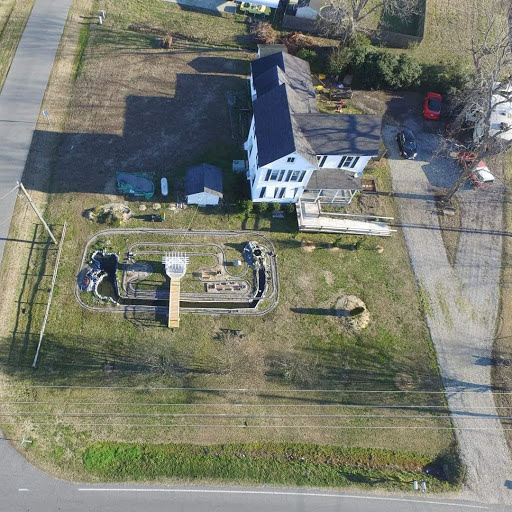
Our first garden train layout was laid down in 2013 at Chesapeake Campground. We had a largish indoor model train layout in the campground recreation room so people were always bringing by train related “stuff”. One thing that seemed to accumulate was plastic track and battery powered trains in G Scale. It was much too big to set up inside the Train Room so we did a land grab for the front yard of the rec room. It was plastic track and battery operated trains. While my husband had experience with O Gauge, HO and N scale trains he really didn’t know much about G Scale and running trains outside. And I had no clue about any of it. It showed when we set up our first tracks.
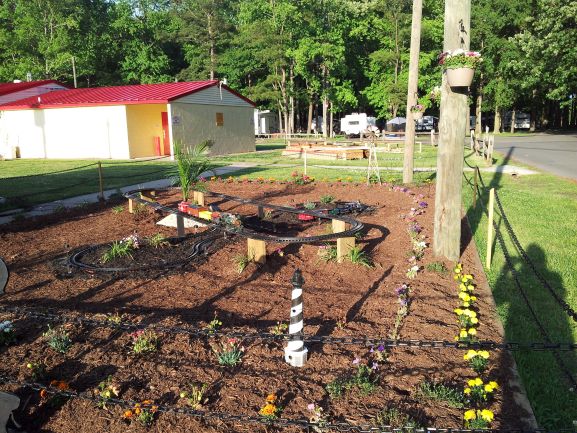
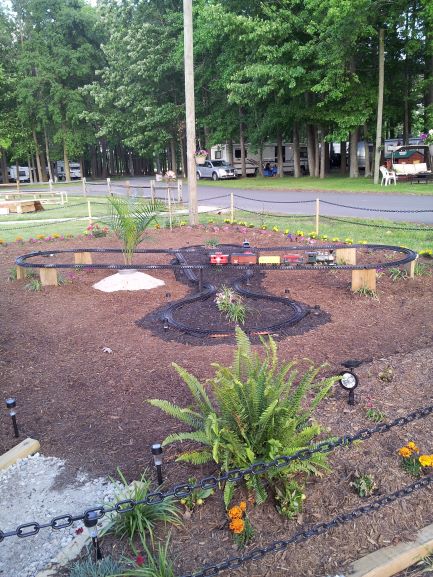
The upper level track wasn’t supported well enough and the black plastic track expanded and contracted a LOT in the sun. We never got the trains running all that well but it was fun and folks in the campground who knew even less than us thought it was neat. We were hooked.
In 2015 we moved up to the big leagues. Or at least Triple-A ball. We acquired some LGB brass track and a couple more respectable engines with cars to run on it. We put in a rail bed of crush and run gravel, laid our track down on it and ran trains.
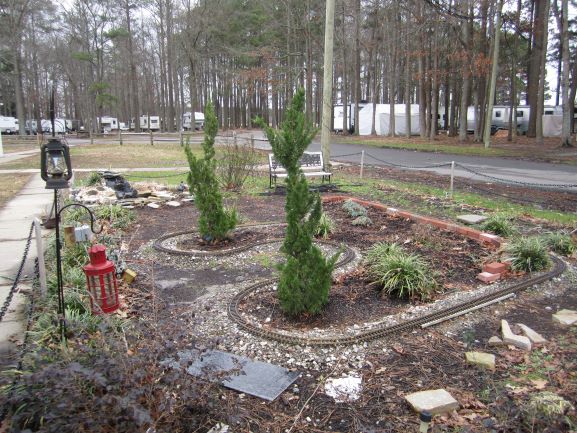
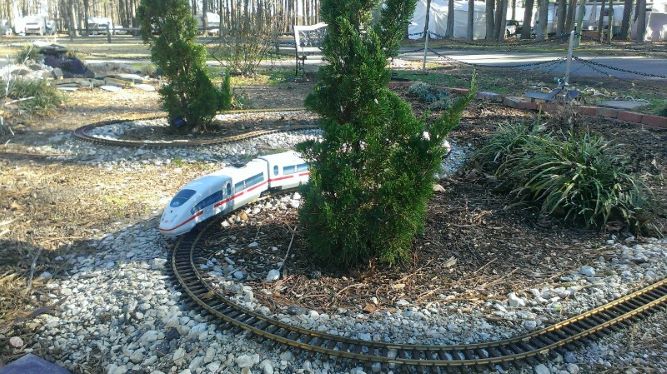
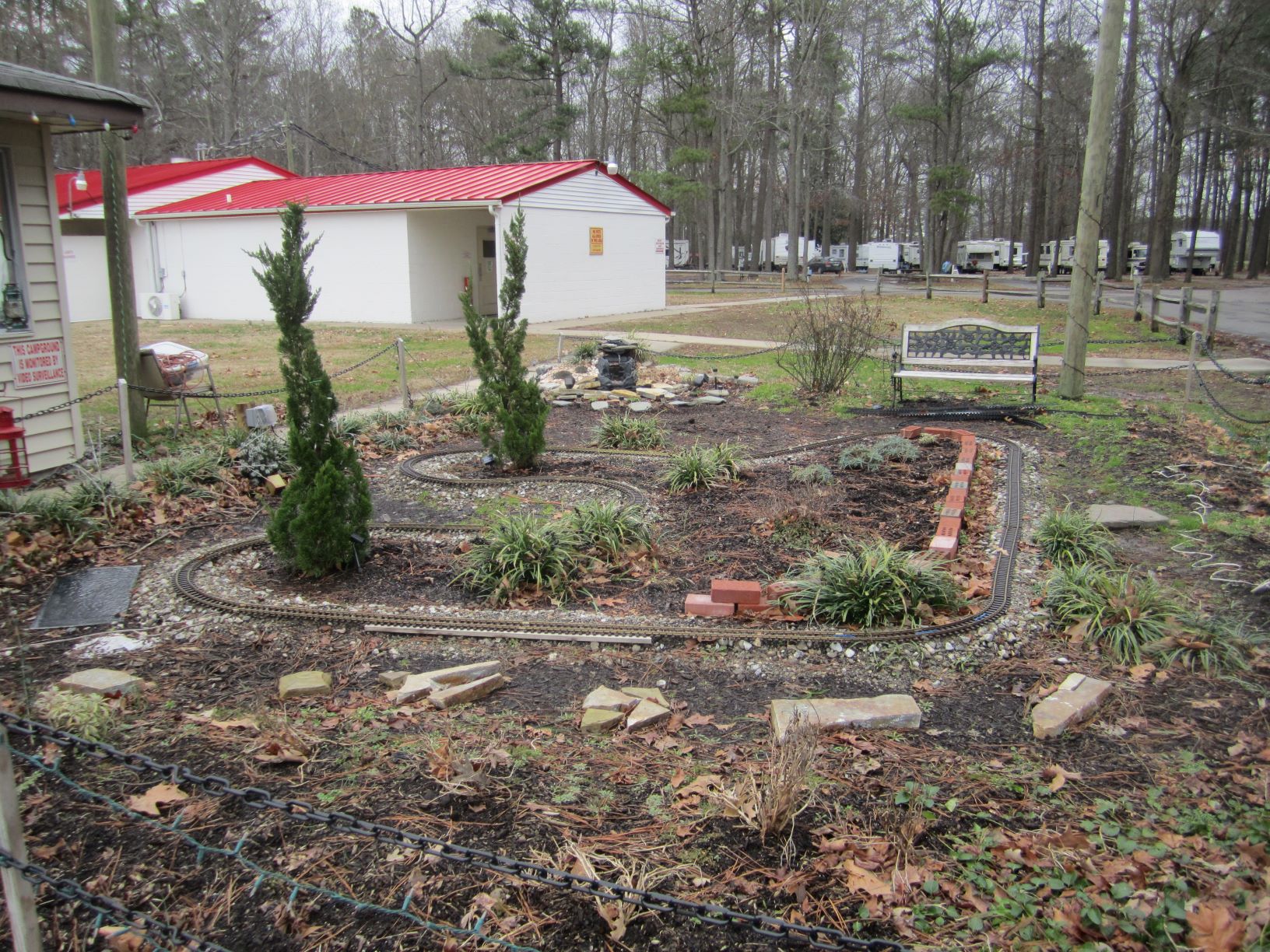
Around this time we also started to participate in train shows with the club we had joined – the Tidewater Big Train Operators. We were having fun with our layout, but doing the shows we started to see that we still had a lot to learn. Who knew that a track that goes in an “S” curve is a bad thing or that most trains weren’t going to like the small radius curves we were using.
In the spring of 2016 we bought a house and moved down the road to North Carolina and it wasn’t long before we started planning our new layout. Construction started in May of 2016 and in September of that year we had a layout. A train garden, like any other garden, is never really “done” but we were running trains.

The total area is 65′ by 35′ and we used a mixture of LGB, Aristocraft and USA Trains brass track. Power is analog DC from a pair of Bridgewerks controllers with two track feeds per loop.
The outside loop is 238 feet of track with 16′ diameter curves and a siding. Any train we have can run on this track though we usually reserve it for the larger engines and longer loads. Or for something we want to run really fast. Power can be isolated to the siding so we can stage another train there. We also put in a pair of LGB 8′ switches that lead to and from a future Phase 2 expansion.
Inside the outer loop is a 148 foot circuit using all 8′ curves. All but a couple of our trains will run on this track, but now you are getting to the point where some of the bigger engines and longer cars hang over the inside of the curves and they start to look…well wrong. There is a tunnel in this loop.
The inner most track uses five foot curves and is 125′ long. LGB advertises that all of their trains will run on track with four foot diameter curves, but no one does with the bigger ones. We run small engines usually pulling two axle cars. This track also has a tunnel.
And finally, that squiggly bit is 44 feet of track with a LOT of four foot diameter curves as our trolley/streetcar line. it crosses the center mainline track and we have not quite worked out yet how to avoid collisions so this track isn’t powered yet.
 Dismal Creek Railroad